

Six weeks with the women of Dharmalife in rural India.
I spent six weeks as a research intern at Dharmalife in summer 2026. This piece is published jointly with Dharmalife.
I would like to introduce you to Suman.
Before Dharmalife, many of the women I met were not known by their own name. They were known as someone’s wife. Suman said it plainly. She was a housewife, or known by her husband’s name. Through Dharmalife she got a smartphone. She had never held one. She taught herself to stitch from videos on it. Other things she learned from Dharmalife directly, through their training and campaigns. Menstrual health. Her own body. The climate changing around the fields. She started passing it on. People began coming to her with questions. Now they know her as Suman.
She does not claim that things are equal now. The differences, she said, have not been eliminated. They have faded.
Meena Devi does not cover her face anymore. In her village that is a decision. When she wanted to join Dharmalife, her whole family was against it. Only her husband stood with her. People told her that lifting her sari off her face was disrespectful. That her place was at home, caring for her family. She joined anyway, and she lifted her sari. She showed me how she used to wear it, pulled down over her face, and for a moment the woman who had been talking to me was gone. Then she lifted it again. It should always have been her choice. She said Dharmalife gave her the courage to make it.
She has done this for ten years. She sells induction cookers, seventy or eighty of them. That money paid for her daughter to go to teacher college. Her daughter teaches now. She helped her son too. Her proudest moment had nothing to do with a sale. She said it was proving to her family and her village that she could do work with dignity. She was smiling the whole time. There are people whose smile does not reach their eyes. Meena was smiling with her heart.
She almost never became any of this. A field coordinator came to her house looking for her older sister. The sister was not home. Meena opened the door.
She is president of her group now. Ten women. It is called Ujala. The word means light in Hindi. She runs it on three rules. Everyone takes part. Everyone is held to the same standard. Whatever they earn together is shared equally.
In the same group, Taruna is the treasurer. She understands the money better than anyone else there. She sells yarn she makes herself. Before that, saris, then soaps, then papad. She knows exactly why things fail. The soap did not work because the raw materials were not available nearby and the alternatives cost too much. They cannot sell leaf plates because local families already collect the leaves for free. She brought four other women into Dharmalife before the group even existed. She goes to the computer center alone. Other women watch her go alone and decide they can do the same.
She told me something I did not expect from the most independent woman in the room. Behind every woman who succeeds here, she said, there is a husband or a family helping her. It is hard to do it alone.
Taruna is also the one who explained what the savings are for. The group has around three thousand rupees. This is by no means a lot, but a beginning. She does not want it sitting in ten separate little piles. She wants it pooled, to buy into a business together, and once the pool is large enough, to lend from it to any member who needs money fast. The thing stopping every woman is the same. No cash in hand at the moment she needs it. To her the lending is not a nice idea for later. It is the point.
Suman, Meena and Taruna are three women. More than twenty-six thousand have walked the same road with Dharmalife.
The model is simple. Find one woman in a village. Train her. Give her products worth selling: solar lights, cookstoves, water purifiers, sanitary napkins, smartphones. Let her keep the margin. Then send her out with the campaigns that go with the goods, on menstrual health, on clean cooking, on bringing the next woman out of the house and into work.
One woman becomes the person the village asks for help. Since 2009 that has become 45,000 villages across 16 states, and 17.5 million people who are reached by someone the whole village knows by name.
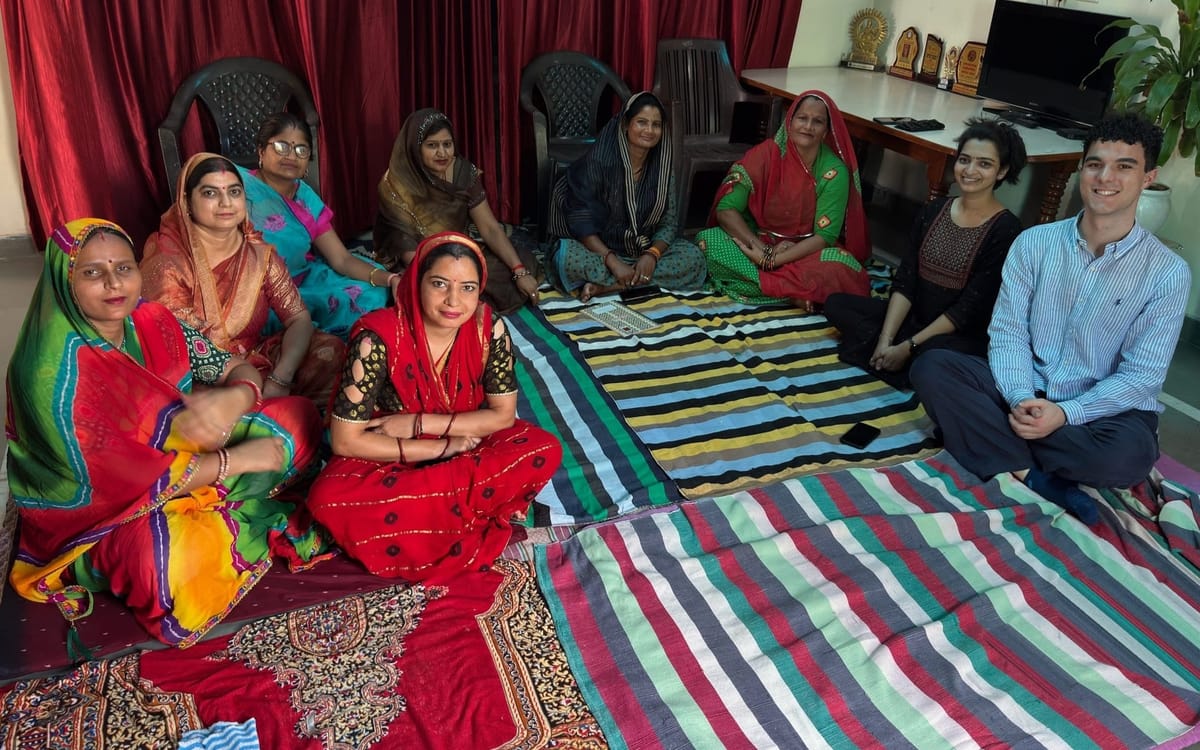
After more than three weeks in the Delhi office, I finally went to meet them. We left by car early in the morning and reached Alwar several hours later. We sat with the women on the floor of the entrance hall, in a circle. Their hospitality was like nothing I had known. Drinks and food arrived before anyone had really spoken. I declined the food for health reasons and tried the hot sauce instead. I found out my spice tolerance is better than I thought.
That group met in a comfortable house. Afterwards we visited four women, one after another, who want to start a group of their own. They lived further out, down field paths barely wider than the car, still half under water from the monsoon the week before. In two of the homes we walked straight into a room with woven beds and sat talking on them. That night, after we left, the family would sleep there.
One of those women was also named Suman. She joined in 2016 and learned to use a phone through the program. Then she went further than anyone else I met. She bought a printer with Dharmalife’s help and used what she earned to open her own shop: printing, internet, the small services a village cannot do without. She began with a phone she could not switch on. She ended up running the place her village goes to when it needs something printed, filed, or ordered.
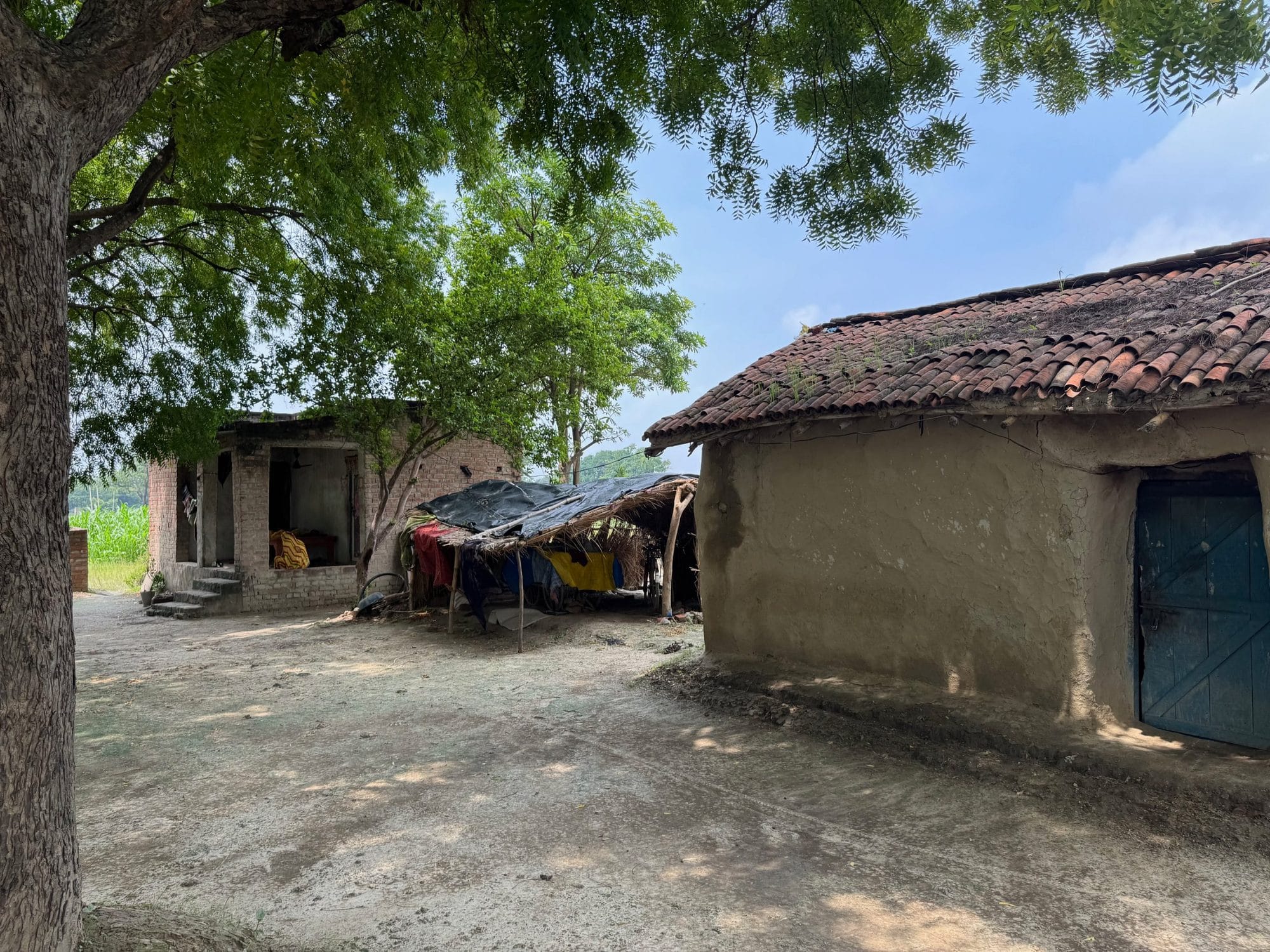
Later we went to the outskirts of Varanasi. The women I met there lived in a house built of clay. They pumped their water up from the ground by hand and washed their clothes in large bowls. The city was only a short drive behind us. It felt much further. In India you do not have to travel far to cross from one world into another. The crowded lanes and the horns end, the fields begin, and so does a different life.
Aarti I could not visit. She lives in Maharashtra, so we spoke over a video call, and she was laughing before it had properly connected. She is treasurer of her Dharmalife group, Swalambhi. Beyond it she is connected to fourteen or fifteen villages and around two hundred and fifty women through the local self-help groups. She does not speak Hindi. She spoke in her own language, a field coordinator turned it into Hindi, and Parvathi, my colleague, turned the Hindi into English for me. I have no honest idea how much of her reached me, but more than enough.
I did not find any of these women on my own. Meena joined because a field coordinator knocked on her door, and that is still how it works. The coordinators drive for hours down flooded field paths to sit on a floor and listen. They know the women by name, and the women know them. Parvathi came with me to every village and translated every conversation. Without her I would have heard nothing. Back in the Delhi office, the IT team turns ideas into things that actually work, the call center stays on the phone with the women, answering their questions, and the rest of the staff keep all of it running so the work can reach the next village. I came to India to study how credit reaches women in rural villages. What I learned is that it reaches them through people.
None of this is what I was told to expect. My family and most of my friends were curious about the trip and what I would come back with. Some people were not. India is a country that only abuses women, they said, and nothing Dharmalife could do would change that. It was dangerous. I would get seriously sick. Diarrhea would be a daily event. I would be lucky to make it out alive. On the flight over, where I seemed to be the only tourist, a Lufthansa steward told me in German to watch myself. I seemed like a nice person, he said, and India knows how to take advantage of nice people.
I started writing this at the end of my internship, a few days before I left. I am finishing it at home. I did not get sick. I was not robbed. I came home with more than I left with, and not only in my suitcase.
I have also not seen the mountains of trash on every corner that I was promised. There is trash. No question about that. But India is a country of stark contrasts. Delhi surprised me. I expected concrete and heat and found lush trees leaning over the roads and green in places I did not expect. I stood in front of the Taj Mahal in Agra. I walked the old streets of Jaipur. I watched the Ganges move through Rishikesh. I saw skyscrapers towering into the sky, competing with each other for the sunlight. And then, every morning, my Uber pulled out of the hotel’s gated perimeter, turned the corner, and there it was. People sorting through trash. Cooking over open fires. Sleeping on the ground.
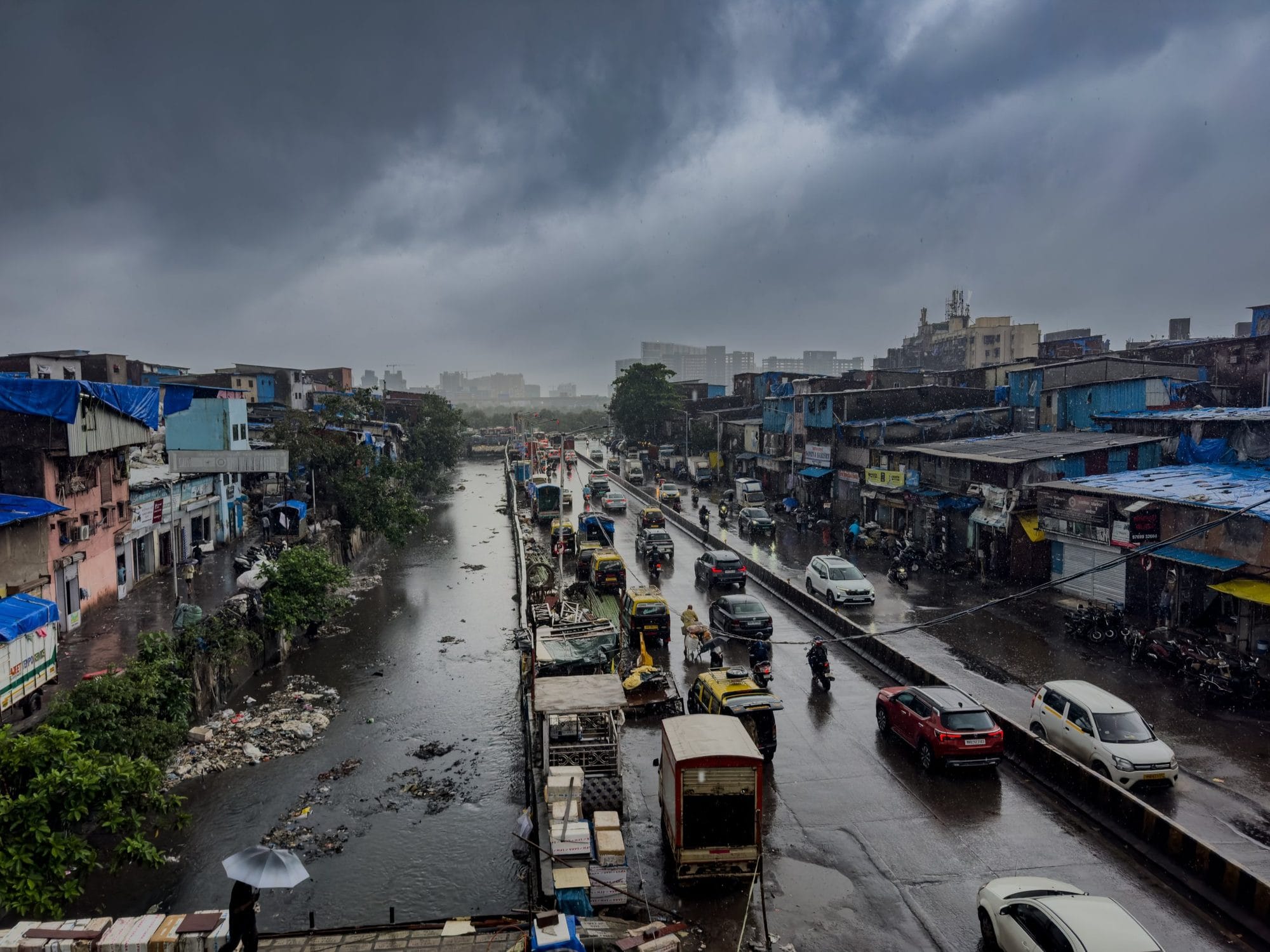
In Mumbai, on a day of my own, I went to Dharavi, one of the largest informal settlements in Asia. Hundreds of thousands of people live and work there, in the shadow of the same kind of towers. If you picture a place like that as standing still, you would be wrong. The monsoon had wrapped the city in rain clouds, and Dharavi was buzzing anyway. Thousands of deals happening at the same time, all around me.
I had never seen children beg for money before I came here. On my first day walking through Delhi, a girl no older than seven came running up to me, barefoot, tugging at my shirt, asking for money. It did not happen only once. It happened often, especially from the car. When we stopped at an intersection, children would come to the windows and knock.
I do not know what happens to that girl. I know what happened to Meena’s daughter. She teaches now. Her mother’s cookers paid for it.
The children at the car windows will not leave me. Neither will Meena, standing in her village with her face uncovered, known by her own name.
“There is no tool for development more effective than the empowerment of women.” ~ Kofi Annan