

Only one in five pairs of African cities has a direct flight, and fares are the highest in the world. The network still reflects who it was built for, and the cost shows up in trade that never happens. I built an index to measure what flying costs as a share of income, to your neighbours and to the rest of the world, country by country.
Wiza Jalakasi was invited to speak at an event in the Benin Republic. One day, one engagement, a six and a half hour flight from Johannesburg if the route existed. It does not.
So he flew to Malawi. Then to Addis Ababa. Then to Benin Republic. The return took the same route in reverse. He spent two nights in Ethiopia to spend one day in Benin Republic.
"I spent more time on each individual leg than I did at the actual destination," he told me. Jalakasi is Commercial Lead for Middle East & Africa at EBANX, processing payments for global companies in emerging markets, and has flown 33 sectors this year. He has plenty of other examples. "It's a two-hour flight from Johannesburg to Lilongwe," he says. "The cheapest return economy ticket I've ever paid is $700. There's no Ryanair equivalent here."
Libreville and Bangui sit 1,000 kilometres apart, roughly Paris to Madrid, and the trip takes nine hours, one connection, and about $1,000. A one-way ticket from Nairobi to Lagos can cost around $900. Nairobi to Dubai, a longer flight, costs about $675. Lagos to Kinshasa has no direct flight at all, so you go via Europe or Dubai. Between Cape Town and Lagos, two of the continent's most important cities, no direct service has ever existed.
Africa holds nearly a fifth of the world's population and accounts for less than 3 percent of global air traffic. Only 19 percent of city pairs have a direct connection, and even before the pandemic just 9 percent of traffic on the continent was intra-African. IATA rates African airfares the highest in the world.
Africa is also far bigger than most people picture. At about 30 million square kilometres, it is roughly three times the size of the United States and three times the size of Europe. Roads and railways don't cover those distances well, so between most African capitals, flying is the only realistic way to travel.
All of this applies to travel within Africa. Routes off the continent are well served. Abidjan to Paris, Johannesburg to London, Lagos to London, global and African carriers have flown these for decades.
Why it costs so much
"The structural problem is that non-hub-and-spoke routes are simply too expensive to operate. Smaller regional airlines don't run hub-and-spoke models, they feed into and out of major hubs. Malawi's national airline flies to Johannesburg twice a day, to Nairobi twice a week, and domestically to Lusaka and Harare. Predominantly they're feeding hubs where other airlines bring passengers who want to connect inward," Jalakasi says.
In many African countries the airport charges exceed the base fare. Thirty-two of 53 African airports charge above $50 per traveller and ten charge more than $100, against a European average near $30. Abuja and Lagos are the most expensive on the continent. Jalakasi is blunter: "And the airport taxes are insane."
Jet fuel runs up to 40 percent above the global average because refining capacity is limited and almost everything has to be imported. It therefore takes up more of the cost base, 30 to 40 percent of operating costs for African carriers against a global average of 20 to 25, which means a price shock that is uncomfortable for a European airline can be existential for an African one.
Around 70 percent of those imports pass through the Strait of Hormuz, so the cost of flying between Lagos and Nairobi is partly set by events in the Persian Gulf. In March 2026, Reuters reported that with Hormuz shipping nearly halted, jet fuel in northwest Europe hit record highs near $239 a barrel and coastal South African airports saw prices rise 70 percent in a single week. FlySafair, which does not hedge, estimated an additional $2,071 per flight hour for each of its fleets aircrafts. One charter operator described negotiating fuel prices on arrival and finding them changed by the time they landed. South Africa was holding three to four weeks of stock, Kenya around 50 days, Zambia ten.
Governments also charge foreign airlines more for overflight and operating rights, protecting national carriers from the competition that would lower prices. The stated purpose is to defend a strategic national asset.
The costs feed each other. With few airlines on a route, nobody competes on price, so fees stay high and passengers stay away.
Then there is what you pay after the ticket. "Then there's the visa problem. I'm heading to Lagos in a few weeks. I have to apply for a visa on arrival approval, $140, single entry, every time," Jalakasi says. To do his job he has no alternative, and the cost is as much in time as in money. "I have team members joining from other African countries facing the same thing. I had a Nigerian colleague who missed a meeting in South Africa because he couldn't get a visa for a one-day visit."
Who drew the map
Air connections follow trade levels, diplomatic relations, and whether a route can pay for itself. So a route map shows which trade relationships were worth serving when it was drawn.
The main routes ran along South-North lines, connecting colonies to European capitals. Sabena flew Brussels to Léopoldville.
The colonial period did leave some regional links. Carriers like West African Airways and East African Airways ran routes between neighbouring colonies, one of them hopping along the coast from Dakar to Cotonou. After independence, those shared networks gave way to national ones. New states founded their own airlines within the first years of sovereignty, mostly as symbols of it, and the money and expertise often came from the former colonial carriers. Air Afrique, founded in 1961 by eleven francophone states as a shared airline, was one third owned by Air France and UAT.
Independence left 54 separate regulatory regimes in place of one colonial system. Air France can fly to Germany or Spain as freely as it flies at home, and African carriers have no equivalent right. Every border has to be negotiated, and every route is a bilateral deal between two governments, each with a national carrier to protect.
What it costs today
Intra-African trade was about 15 percent of total African trade in 2024. Within the EU the figure is around 60.
Explaining that gap with aviation alone would be short sighted. Tariffs, customs delays, road and port quality, currency risk and political instability all feed into the same number, and no study I found separates them cleanly. Flights are one input among several.
So I built the Runway Index. It covers 184 countries and, for each one, prices the average fare from its main hub to the seven most economically relevant regional neighbours and to seventeen global gateway cities, then expresses both as a percentage of monthly income. A score of 50 means connectivity costs half a month of income (GDP per Capita). The two halves are weighted equally. The 2026 edition averages two collections, one in summer and one in autumn.
Ireland scores 2.62, Singapore 3.37, Norway 3.38. Sudan scores 2720.64. South Sudan 2226.39. Central African Republic 1959.52. Seventeen of the twenty most expensive countries in the index are African.
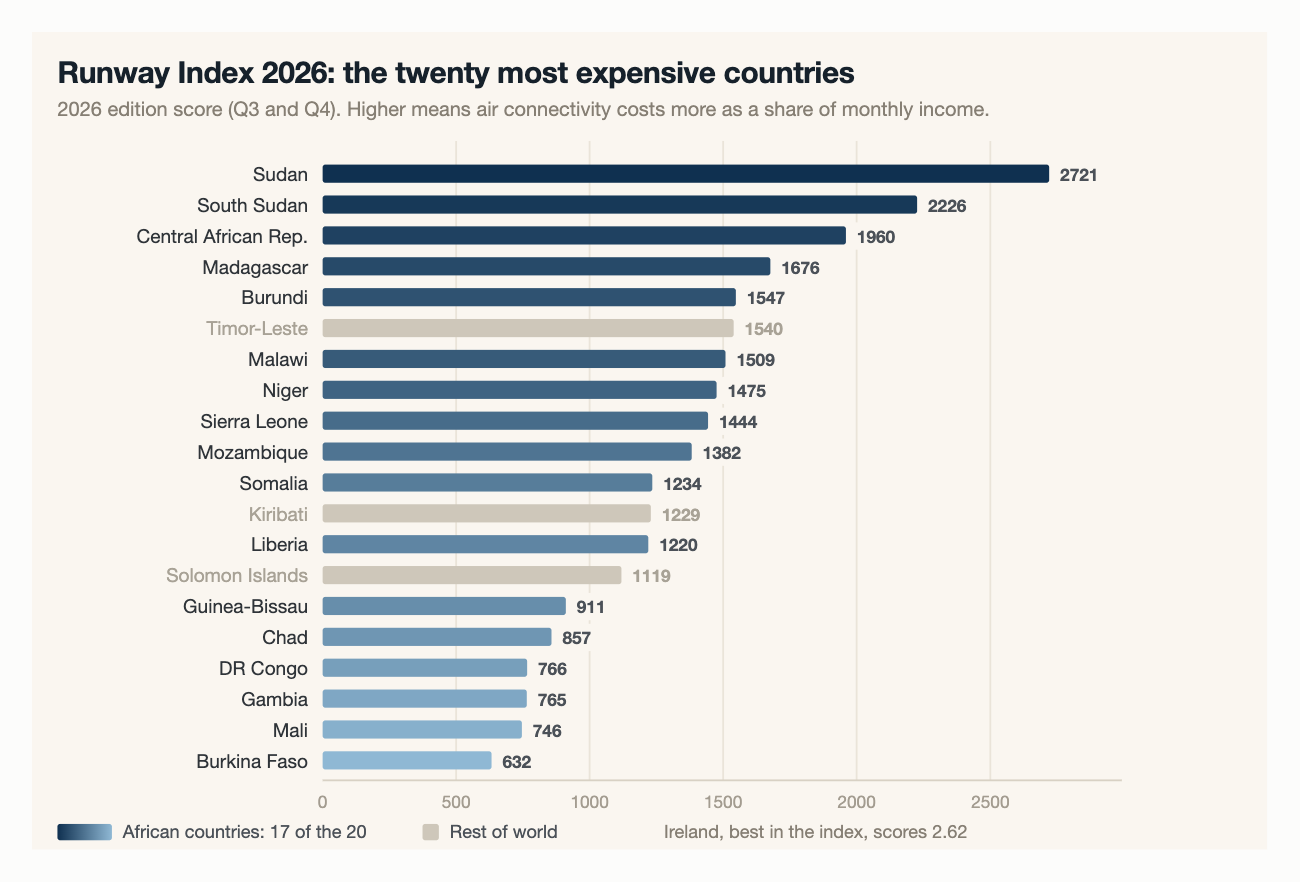
The regional half is where Jalakasi's itinerary stops being anecdotal. Malawi's local score is 995.75, so reaching seven of its neighbours costs almost ten months of income. His $700 return to Lilongwe is priced for someone earning a South African salary, not a Malawian one. Nigeria's local score is 375.64 and Ethiopia's is 454.26, despite Ethiopian being the continent's largest airline. Ireland reaches its seven neighbours for 0.64 percent of a month's income. Its GDP is inflated by the profits of multinational companies; measured on GNI*, its overall score would be 4.36.
Seychelles is the best-placed African country at 45.76, 69th of 184. South Africa, the strongest mainland performer, scores 57.62 and sits 77th, between Kosovo and Armenia. Below it the pattern holds regardless of income, hub quality or region. Gabon sits at 97.77 and Morocco at 100.81.
The map shows the 2026 edition score, combining summer and autumn fares, with local and global costs weighted equally, as a percentage of monthly income. Higher means flying costs more relative to what people earn. Eritrea is not scored because there is no IMF income estimate for 2026, and Western Sahara is not covered.
A Kenyan flower farmer pays more to ship to Ghana than to Europe, so the nearest market goes unused. Businesses walk away from contracts once travel cost is priced in. Investment stays low, and millions of people never enter the tourism economy at all. None of it shows up as a number anywhere. It just never happens.
Where African governments have opened a route, the results came quickly. After South Africa and Kenya liberalised flights between them in the early 2000s, passenger traffic rose 69 percent. When a low-cost carrier was allowed onto the Johannesburg–Lusaka route, discount fares fell 38 percent and traffic rose by the same amount. A 2014 IATA study put the value of liberalizing just 12 African countries at 81 percent more traffic, $1.3 billion in GDP, and 155,000 jobs.
Jalakasi points out how old that study is. "And that's from 2014. The numbers would be even higher now," he says. "It's a real economic argument. The political will is what's missing."
He is right. A later continental study for AFCAC, modelling full liberalisation across the African Union, projects 51 percent more traffic within Africa, fares about a quarter lower, and direct flights between 145 more pairs of countries. It puts the gain at $4 billion in GDP and nearly 590,000 jobs, only about 0.1 percent of the continent's economy. Cheaper flights alone won't close the trade gap.
Traffic between Cape Town and Lagos grew 67 percent year on year, and the route has never had a direct flight. Abidjan to Johannesburg is up 33 percent. Dakar to Nairobi is up 23, on journeys that can still take a full day. Passengers already make these trips, just with connections.
Thirty years of agreements
The Yamoussoukro Decision arrived in 1999, committing African states to open their skies to each other, and is nowhere near full implementation. SAATM followed in 2018 and now covers 34 countries, more than 80 percent of the continent's aviation market, on paper. Some countries keep landing fees high specifically to discourage other African carriers from flying in.
Visas are the same story. By the end of 2022, only 27 percent of African routes allowed visa-free travel for Africans. Four countries, Benin, Kenya, Seychelles and the Gambia, let all African passport holders in without a visa. Aliko Dangote, the richest person on the continent, has complained publicly about watching colleagues with British passports cross borders he is still negotiating.
"The policy changes that need to happen for immigration and aviation, they're obvious, but the political incentives to make them aren't there," Jalakasi says.
So why does this persist when so much of Africa's payments infrastructure was built by the private sector?
"It's always easier to move bits than atoms," he says. "Anything involving physical infrastructure has far more friction, there's something people can see and touch and tax and control. That creates much more resistance to change."
He sees the same problem across other joint infrastructure. "The African Union has not largely succeeded at integrating things the way the EU has," he says. "African countries are still thinking in isolation, optimizing for their local environment rather than the continental one. That's improving, but slowly."
He is not optimistic about the timeline. "Unifying the air market is very low on the priority list of any given African government right now." He thinks it might change with the next generation. "But I don't think it's going to happen in the next decade. I hope it starts to happen in the next ten years."
What is changing
Ethiopian Airlines flies to more than 60 destinations across Africa and carried 13.9 million passengers in the year to June 2023. In early 2024 it held 14.4 percent of all seat capacity within Africa, more than any other airline. Rwanda is small and landlocked, with a limited home market, and has built a hub in Kigali anyway. RwandAir nearly doubled its London frequency and took share from Emirates, Turkish and KLM on the Entebbe to London market.
AFRAA projected in 2024 that African airlines would pass 100 million passengers for the first time in 2025. Boeing expects African air traffic to grow about 6 percent a year through 2044, with the fleet doubling. Airbus expects Africa to need 15,000 more pilots, 20,000 technicians and 24,000 cabin crew over the next twenty years.
Free Route Airspace is now live across parts of West and Central Africa, letting airlines fly efficient paths instead of fixed corridors, which saves fuel on every sector. In May 2026, Kenya Airways and Rubis signed an agreement to build Africa's first dedicated sustainable aviation fuel refinery near Nairobi, 32,000 tonnes a year at a cost of $70 to $82 million. It is small against continental demand, but it is the first plant on the continent built for sustainable aviation fuel.
IATA still expects African carriers to be among the world's least profitable in 2026, squeezed by operating costs and infrastructure.
Closing
Better intra-African connectivity is not just about getting from A to B more conveniently. When flights become cheaper and more direct, business travel picks up, trade between cities grows, and investors start looking at African markets as connected rather than isolated. The economic ripple effect of simply being able to fly between two capitals without routing through Europe or the Gulf will positively shape business.
"The division of labour is limited by the extent of the market." Adam Smith, The Wealth of Nations, 1776