

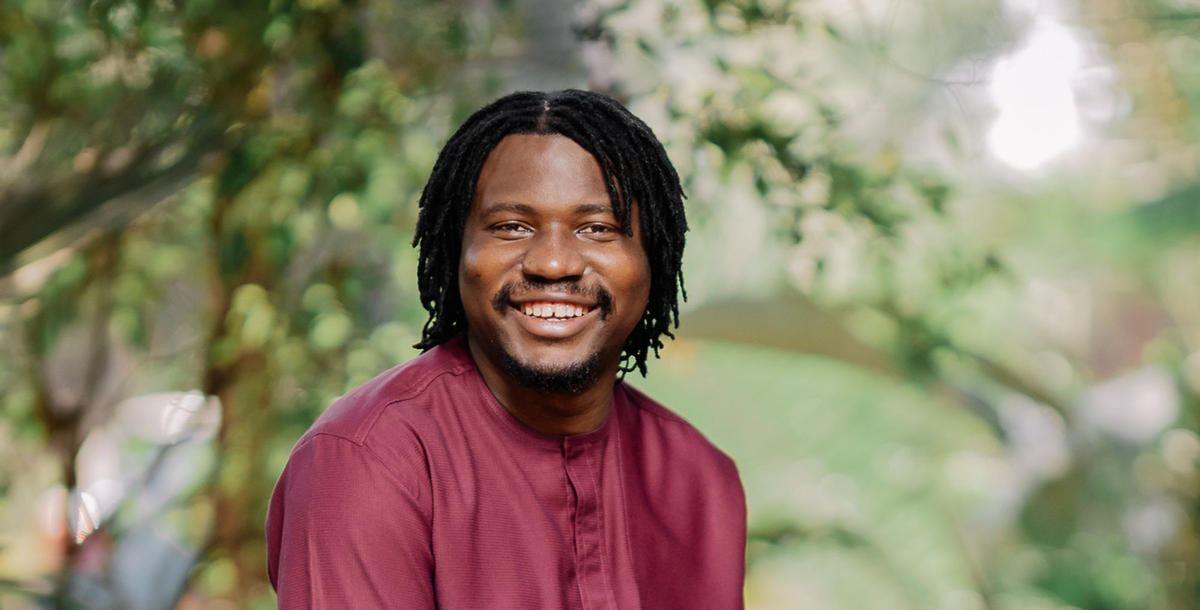
Wiza Jalakasi has spent fifteen years building the infrastructure layer that makes African digital economies run. What he has learned about capital, fragmentation, and the continent's future is not what most investors expect to hear.
When I spoke to Wiza Jalakasi he was in Johannesburg, about to leave for a conference in Amsterdam, just back from Shanghai. It was a Friday. He had already flown 33 times that year and it was not even June. Wiza Jalakasi is not the kind of person who avoids the spotlight. He speaks at conferences, he posts on social media, he has done his share of interviews.
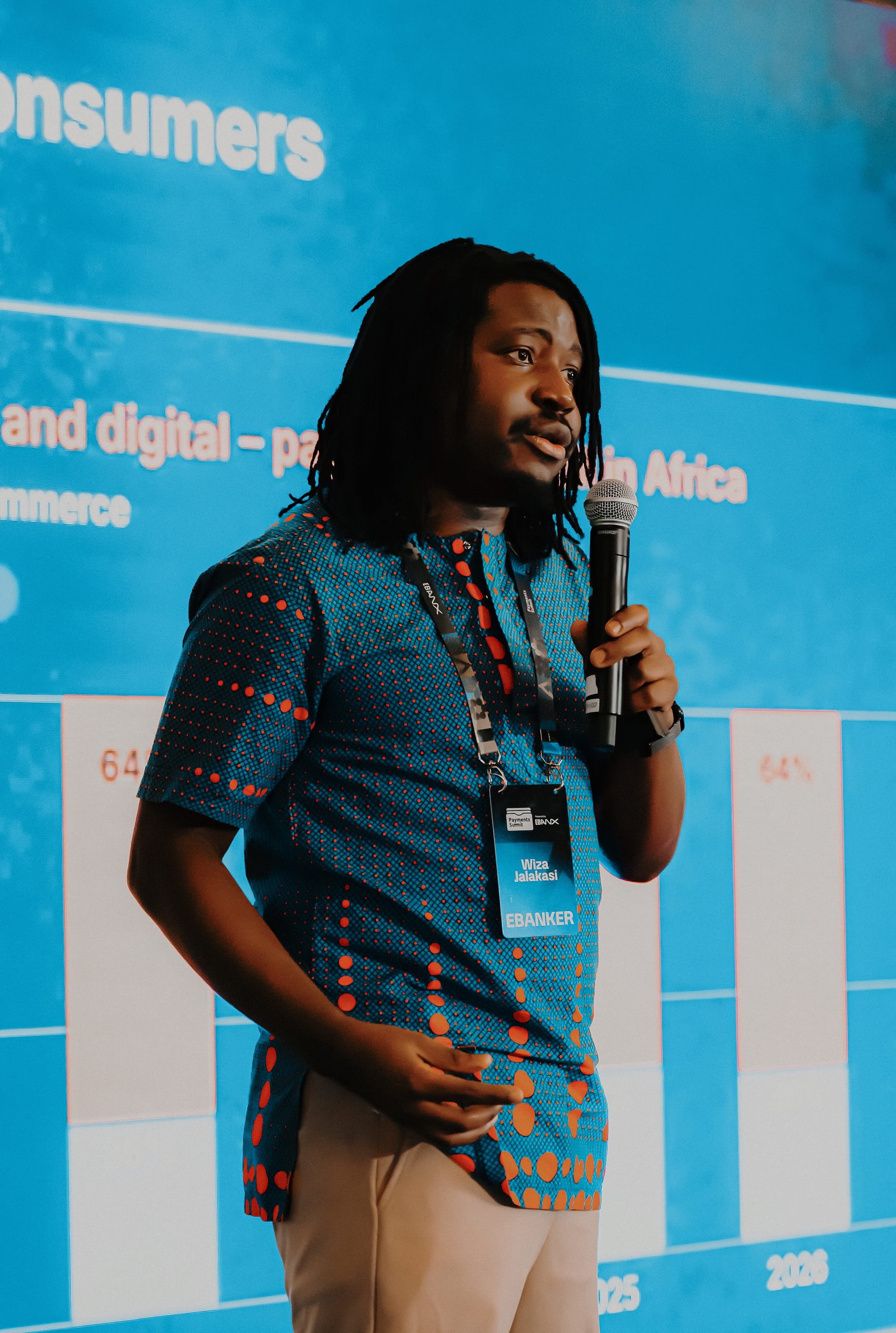
He started programming in Blantyre, Malawi, built his first company at sixteen, and spent fifteen years moving through the infrastructure layer of African digital economies. The payments rails, the API layers, the merchant pipelines that make it all run. Africa's Talking. Chipper Cash. EBANX. He started in one of the smallest countries on the continent and ended up running commercial operations across the Middle East and Africa.
On his website, beneath everything else, sit three words: We move, regardless.
After talking for an hour it becomes clear that those three words are not a slogan. They are the only honest way to describe how he has navigated a career built across some of the most difficult operating environments in the world.
His story
Wiza Jalakasi grew up around computers before most people in Malawi had seen one. His father imported them from South Africa, which meant there were always machines in the house that needed setting up, and a curious child who wanted to help. "For me it was just a way of spending time with my dad," he says. "But then I got genuinely fascinated by it and started learning to program. At ten years old I was already writing Basic."
By sixteen he had turned that fascination into a business. Mobile internet was arriving in Malawi and he taught himself web development, not out of ambition exactly, but because it seemed like a skill he could turn into money. What he built was MWTunes, a music download platform for Malawian artists, at roughly the same moment Spotify was launching on the other side of the world. He built it partly because he saw the gap and partly because it made him cool with a crowd he was not otherwise cool with. It reached 10,000 visitors a month at its peak. When he left for university in Nairobi the chapter closed, but the instinct that built it did not.
In Nairobi he started over. A mobile market research startup called Djuaji Research got accepted into the Savannah Fund accelerator and raised an early investment of $30,000. It did not work out either. What it did was land him at Africa's Talking, a company building telecoms API infrastructure across the continent, the kind of plumbing that makes mobile services possible. He spent three and a half years there scaling across 15 African markets. He did not know it yet but he was teaching himself payments. "Because payments in Africa were mobile, I had inadvertently learned everything I needed to know about mobile payments just by building telecoms APIs."
The path from there to his current role at EBANX winds through a company called Hover, which was building developer tools for mobile financial services but ran into scalability problems. What came next started with a tweet. He wrote a review of the Chipper Cash app on Twitter, the founders got in touch, first he helped them recruit and eventually they asked him to build their entire merchant business from scratch – payments, merchant needs, integration, treasury, regulation, all of it from zero on top of an existing wallet. "That," he says, "prepared me for my current role at EBANX, where we serve some of the world's largest global merchants." According to their website they serve merchants like Sony, Spotify and Uber.
He describes the whole journey as incremental, one thing leading to the next, none of it planned. "I often joke that I'm a computer programmer who has never been hired to write code and has somehow just ended up in management."
The fragmentation problem
Wiza Jalakasi has a simple way of explaining what fragmentation costs. In Europe, a single license gives you access to a market of hundreds of millions. In Africa, you go country by country, and you have to combine multiple markets just to get a business opportunity comparable in size to one large European or US market. You do more work across more jurisdictions to generate the same dollar value.
The regulatory dimension is only the beginning. "Half the continent speaks English, the other half French, some Portuguese, the north Arabic." "I always find it amusing,", he says, "when I hear about one EMEA person covering Europe, the Middle East, and all the different African countries." You cannot have that. You need local people in each market to navigate the ecosystem. Cultural fragmentation compounds the linguistic – doing business in Nigeria is fundamentally different from Kenya, which is fundamentally different from South Africa. The way people pay, the way they trust, the way they decide. At EBANX he has people in every country precisely because he knows he cannot deliver the results required on his own.
Then there is Ethiopia. On one trip for Africa's Talking, his team flew into Addis Ababa carrying physical servers to install in a data centre. They had signed contracts proving they had purchased the space. They arrived at the building and were told they could not enter because they did not speak Amharic. It took a phone call to a local partner, and only when that partner arrived at the door did they get in. "Some places make it very difficult." he said. "But there's always a way."
The Ethiopia story is an extreme case. But the underlying logic, infrastructure and rules that assume you are local, runs through every market he has operated in. Nowhere is this clearer than in the movement of people. It is now relatively straightforward to register a company across African borders. Moving the people to run it is another matter entirely. As a Malawian national, a work permit in Kenya once cost him two thousand dollars a year and a process he describes as incredibly cumbersome. In South Africa the first time he applied in July and received his permit in November. The second time he applied in November and was still waiting months later. "It's barely being addressed," he says.
"It's much easier now to move goods with the Continental Free Trade Area Agreement," he says. "But free trade doesn't work without mobility of people." He deeply admires the EU for exactly this reason. You can wake up tomorrow, receive a job offer in France, and go. Africa has nothing like it at that scale. Even within the East African Community, where a Rwandan can technically work in Kenya, the administrative processes remain cumbersome. He traces part of this back to the colonial boundaries themselves – lines drawn without regard for the populations they divided, maintained by governments that are sometimes more interested in outcomes for their own constituencies than for the continent as a whole.
For the people navigating this every day, the difficulty is not an abstraction. It is a data center door that will not open, a work permit that arrives four months late, a visa that cannot be obtained at any price. Jalakasi has never walked away from a market because it was too hard. For the roles he has taken, he says, success was the only option. You cannot go back to your bosses and say you could not expand because it was too hard. So you make a plan.
What Capital gets wrong
Hans Rosling wrote that there are five billion potential consumers in the middle of the global income scale that investors miss because they go around thinking of them as poor. I asked him whether that's how Africa gets misread by outside capital. He felt conflicted about that question.
"It's not the case that the whole continent is uniformly poor," he says. "There are pockets of prosperity." The most reliable data he has seen on this comes from World Data Lab, which segments cities by spending capability – how many people in Lagos, for example, can spend over $100 a day versus $20 versus $5 versus nothing. The picture is deeply nuanced and varies dramatically by city, by country, by segment.
But nuance cuts both ways. "The typical person in most African countries doesn't have the same disposable income as the typical person in Norway." The opportunity is real. The size of the addressable market within that opportunity is frequently overstated.
Malawi has around 20 million people, 80 percent of them smallholder farmers. The largest retail bank there made $50 million in profit last year. "Something is clearly working," he says, "and if you look at the profitability ratios of African banks, they're among the highest in the world – European banks would dream of those margins." Then Nigeria. Two hundred million people, a figure that appears constantly in investor decks as a reason to enter the market. Nigeria's entire GDP is roughly comparable to the GDP of the Greater Boston area in the United States.
"You have to build products at the right price point," he says. "The answer is never Nigeria's a massive market and it's never Africa is too poor. The truth is somewhere in the middle, and that's where the real opportunity lies."
Wiza Jalakasi has a simple answer for what he would show every investor who has never set foot on the continent. Not a spreadsheet. Not a pitch deck. Not a startup demo.
"I would take them to a busy land border.", he says. "Zimbabwe and South Africa. Beit Bridge. Just the amount of activity happening there."
Beit Bridge is one of the busiest land border crossings in Africa. On any given day it processes thousands of people, trucks, and informal traders moving between two countries. What Wiza Jalakasi wants investors to see is not the infrastructure. It is what happens around it.
"You have entire marketplaces. A lot of people got to the border with no intention of crossing – they're doing foreign exchange, accessing banking services, buying and selling." Between Malawi and Zambia, he says, people cross into Zambia just to buy cheaper groceries because inflation in Malawi is high, then come back the same day. Commerce happening in the margins, in the gaps, in the places no index captures.
"Borders in Africa are market bases." Of everything he said in the course of an hour, that line stopped me the most.
One country has not overlooked the opportunities of Africa. China has made serious political and economic inroads into the continent since the 1990s, building infrastructure, extending credit, and establishing trade relationships at a scale no Western power has matched in the same period.
Wiza has watched this play out from the inside. "China has done a very good job positioning itself as a partner for the continent," he says. "People from the West often dismiss that as China just trying to buy influence – and they say it in a very condescending way."
His view is more clear-eyed than either the Western dismissal or the uncritical embrace. Every foreign party with an interest in Africa has its own agenda, he says. That has always been true – European, American, now Eastern. The question is not whether China has an agenda. The question is what Africa can get out of it. "We have our own agenda too."
On the ground, the results are visible. In Lilongwe, Malawi, the parliament building and the best hotel in the city are Chinese builds. When Jalakasi needed a visa for Shanghai, he walked into the Chinese embassy in Malawi and had it in two days, arranged partly over WhatsApp with the consular officer. "Contrast that with the United States, which has banned [or at least heavily restricted] visitor visas for around 40 countries including Malawi." He has colleagues who wanted to meet in New York. He simply couldn't go.
"China is playing a long game. They have an agenda, but that agenda aligns well with the continent's development priorities." In 2025 China recorded $348 billion in bilateral trade with Africa, up 17.7 percent year on year and the 17th consecutive year as the continent's largest trading partner. "The rest of the world has not seen that opportunity as clearly," he says, "and perhaps doesn't have the resources to invest at that scale."
The same logic that explains China's advantage over Western governments explains EBANX's advantage over Western payments companies. EBANX is Brazilian. It was built in a market of similar complexity and that experience translates directly. "There's a very strong cultural similarity between Latin America and Africa," he says. "The fragmentation problem resonates deeply. Africa has 54 countries and is deeply fragmented. Latin America has around a dozen. Understanding that even two neighboring countries can be completely different – that's something global companies consistently struggle with."
The contrast with US companies is stark. "They look at Africa and think: one market. That's simply not how it works. Companies from emerging markets have a clear edge over those that don't" Working inside a Brazilian company, he says, means you don't have to explain as much, "There's a natural understanding of why certain things are necessary. It feels kind of like home."
Where Africa is actually ahead
Ask Wiza Jalakasi where Africa is actually ahead and he does not hesitate. Logistics and payments.
When he lived in Nairobi for five years there was "truly nothing" that he could not get delivered in 45 minutes or less. Whatever you want. The country has 1.6 million motorcycles and all those riders need work. The informal logistics infrastructure that foreign analysts tend to overlook is in practice faster and more reliable than what most European cities can offer.
Payments are the sharper example. He still gets surprised. He has a bank account in the United States, and when someone tries to pay him they send a wire confirmation and tell him it will arrive tomorrow. Tomorrow. "In Nigeria, every transfer is real-time, 24/7, between any banks, up to very large amounts. There's a convenience and immediacy to that which the US banking system simply doesn't have."
These are not catching-up stories. They are leapfrog stories, markets that skipped the incumbent infrastructure and built something better in the space left behind. It is part of why he finds it very hard to leave. "It's extremely convenient," he says. And it is part of why, if he were starting a business today, he would not go anywhere. "I've invested deeply in my networks and my understanding of the local ecosystem. I know how to navigate it, I know how to hire great people here." He would build from Africa. But not Africa alone. "Build from here, but for the world." Nevertheless, if he were younger he'd build somewhere else first where he gets access to the "best global talent."
We move, regardless
Wiza Jalakasi has a personal motto on his website. Three simple words: "We move, regardless" Setbacks have been a very consistent theme across his career. While he acknowledges that's true for anyone's career, the nature and frequency of the setbacks in his career have led him to always expect them.
He has lived those three words many times over. He almost couldn't take the job at his current company EBANX because he did not have the right work permit in South Africa and couldn't get it in time. The solution was to contract with them first, establish residency in the UAE, and split his time between two countries just to make it work. "That roadblock appeared and I had to push through and make a plan."
A similar thing happened while they were setting up Africa's Talking in Malawi. They went to the regulator and explained what they were building. The regulator's response was direct: the business made sense, but there was no regulatory framework for it. No license could be issued. So Jalakasi asked a different question. What about a letter of no objection? They would explain how they intended to operate, how they would report. The regulator agreed. "We can't license you, but we can't stop you." Africa's Talking moved forward regardless.
"There's always a challenge, and it usually requires a creative solution. Where someone else might stop and give up, I need to find a way to move forward. That's the idea."
The stereotypes and the single story
Most people who grow up outside Africa inherit a single image of the continent. Wiza Jalakasi has a direct answer to that, though he is careful to note that the ignorance is less common that it used to be.
During the COVID pandemic, when everyone was locked indoors, he was living in a five bedroom penthouse in Nairobi with coworkers who have since become close friends. They had 100 megabit internet for the same price as in Europe. The hotels were shut down so they hired a private chef, Italian-Kenyan, trained in hotel kitchens, who would come in and cook while they sat on Clubhouse talking about crypto. Strangers on the app would ask what Nairobi was like and be visibly shocked that he lived in an apartment at all.
"Those perspectives are a little stereotype-y and unfortunate," he says. "But it's less common now. We've gotten much better as a continent at telling our own stories." The village narrative, he says, has given way to something more honest, the recognition that this is a serious, modern market.
He uses himself as the example. "I'm here in Johannesburg, talking to you on an ultrawide screen, I have AI agents running on my Mac Mini, I've got my PS5 in the other room." He is not that different from someone in Europe. "I could be anywhere in the world." He has gigabit fiber to his house. He downloaded a game in two minutes last week. He got his Oura Ring delivered the same day. "I might as well be in San Francisco, minus the ecosystem and the venture capital, but in terms of quality of life, it's more or less the same."
When I mentioned I don't even have gigabit fiber in Germany he said one word: "Terrible."
"There's a danger to a single story, the story that people may have heard from outside sources. Broaden your horizons and hear the stories told by the people living them."
The tools to find that better story have never been more accessible. As he put it earlier in our conversation: "We live in a world where there are no secrets anymore because everything is on the internet." The only question is whether people choose to look.
Analytical takeaway
Africa is not a homogenous market. It is the second largest continent with 54 countries, dozens of currencies, four major languages, and consumer behavior varies as dramatically between Lagos and Nairobi as it does between New York and Tokyo. The investors who treat it as a single opportunity are asking the wrong question. The question is not whether Africa is a good market. It is which segment, in which city, at which price point, accessed through which infrastructure. Precision is not optional. It is the entire job. As Jalakasi put it: "you have to build products at the right price point."
Emerging Markets blind spot Most Western capital arrives in emerging markets with a mental model built in a single, homogenous home market. One regulator. One language. One consumer culture. That model does not survive first contact with the reality of fragmented, informal, high-friction environments. Operators who grew up solving those problems elsewhere carry an intuitive understanding that cannot be acquired through due diligence. The question Western investors rarely ask is not what a company has built. It is where it learned to build.
The labour mobility tax is the single largest hidden cost of building across Africa. It is the cost of moving people. Work permits that take months. Visas that cost thousands of dollars per year. Colleagues who cannot cross a border for a one-day meeting. This friction is not addressed properly. The Continental Free Trade Area Agreement moves goods. It does not yet move people. The people who understand that friction correctly will have an edge over those who do not.
Closing
I asked him if there is a question nobody ask but he wished they would.
"I wish more people would ask about where to go on holiday in Africa. There are incredible places – Kenya, South Africa, Tanzania. Cape Town in the summer is absolutely unbelievable. Victoria Falls. Lamu on the Kenyan coast in December is fantastic," he says.
He has a point. Going to the Maasai Mara has been a childhood dream of mine long before I started writing about African markets. Perhaps that is the right order of things, to fall in love with a place before you try to understand it as an investment.
Wiza Jalakasi is always in motion. Johannesburg, Amsterdam, Shanghai. The year is not even half over.
But the motion is not restlessness. It is adaptation. The global order is shifting. Capital flows are changing, infrastructure is being built in places that did not exist on investor maps a decade ago, and the people who understand that earliest are the ones already moving through it. Jalakasi has been moving through it for fifteen years.
Progress means change whether you want it or not. You can try to outrun the wave. At some point you have to start swimming.
As he puts it: we move, regardless.
If you have thoughts on this piece, feedback, or want to get in touch, write to hello@understorymarkets.com