

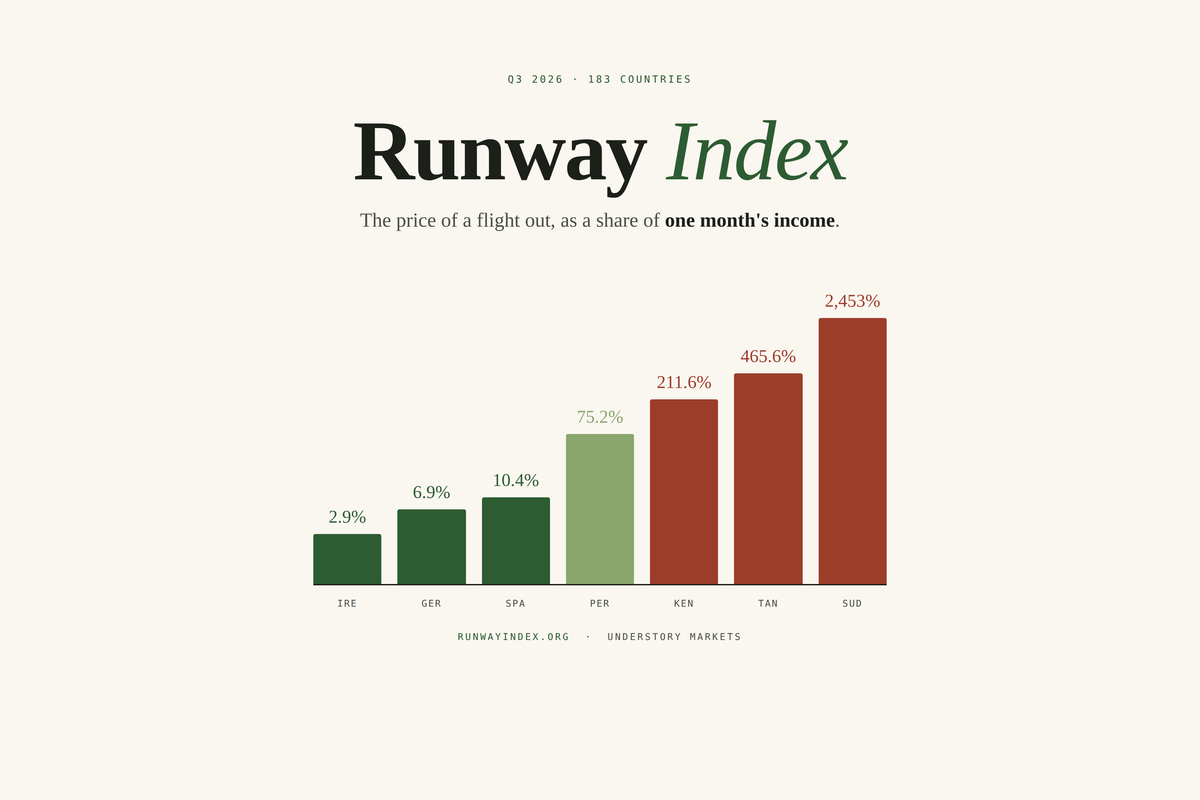
In Ireland, it takes 2.9 percent. In Sudan, it takes 2,453 percent.
That is the gap the Runway Index measures. The third quarter edition covers 183 countries.
How it works
The index asks one question: what does a flight out of your country cost compared with what people there earn?
Each country gets two scores. The local score covers the seven neighbours that matter most to it, chosen from its ten nearest countries by economic size and distance. The global score covers 17 global gateway cities, one or more in every region, from New York and São Paulo to Lagos, Dubai, Mumbai and Sydney.
For each route I record the cheapest one-way economy fare on Google Flights, booked 30 days ahead, across a full week of departures. Stopovers count, because the cheapest route is often not a direct one. I then divide the average fare by monthly GDP per capita, using IMF data.
The final score is half local and half global. A score of 10 means a flight costs 10 percent of a month's income. A score of 200 means two months.
The top of the table looks like Europe
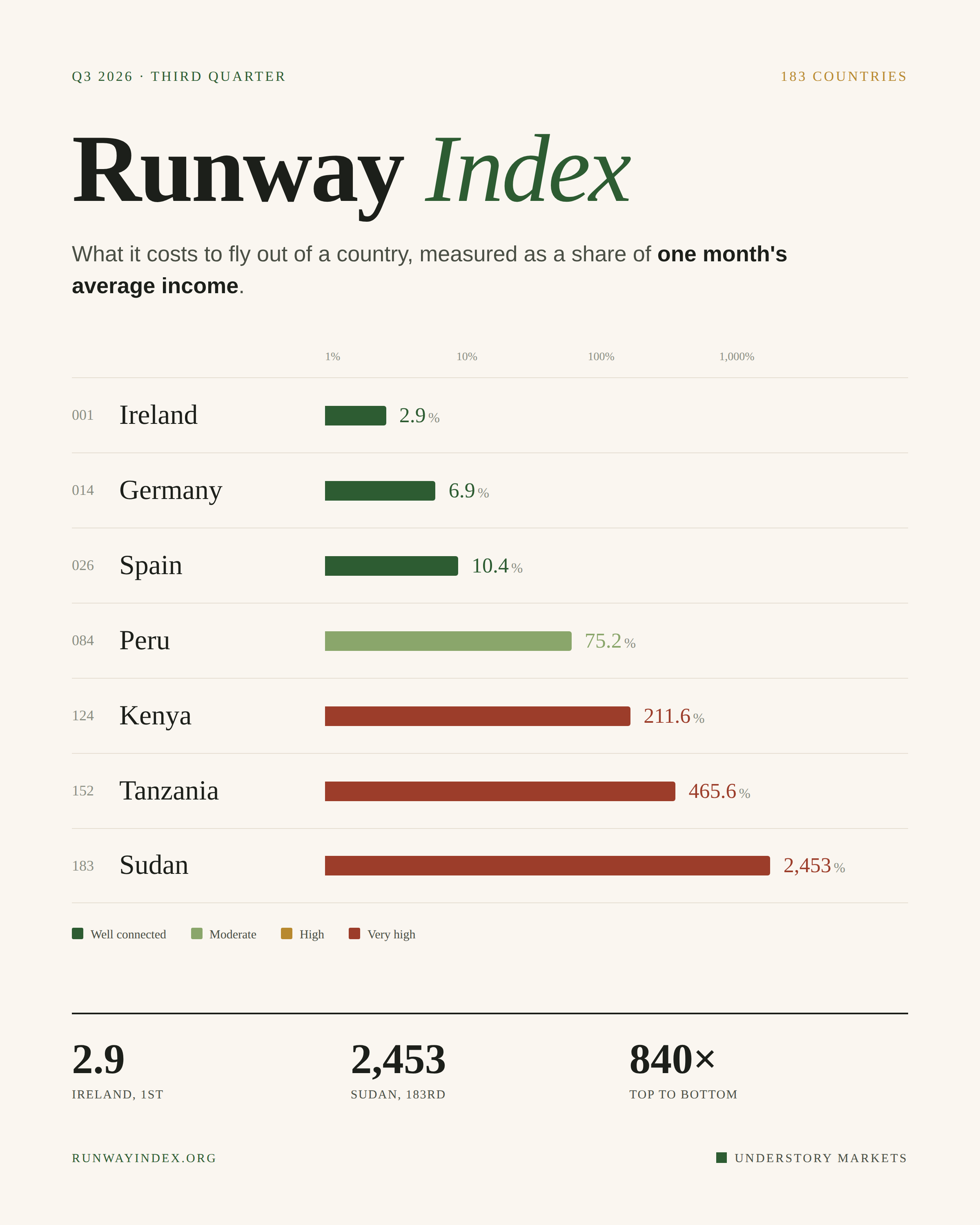
Ireland, Norway, Switzerland, Singapore and Luxembourg lead. Germany is 14th at 6.9 percent and Spain is 26th at 10.4. The United States is 8th and Hong Kong is 13th. The Gulf does well too: Qatar is 16th, the UAE 18th and Bahrain 38th. These places are cheap to fly out of, and they earn enough that a ticket barely registers.
Ireland needs one footnote. Its GDP is inflated by multinational accounting. Using GNI* instead, its score is 4.86, which still puts it near the top.
The bottom of the table
Things change quickly further down. Peru is 84th at 75 percent. Kenya is 124th at 212 percent, so an average Kenyan needs two months of income for one flight. Tanzania, at 152nd, needs almost five months. Sudan is last. Because of the war, the only working airport is Port Sudan, and one ticket out costs more than two years of average income. The Central African Republic, which came last in the first edition, is now second to last at 2,030 percent.
From top to bottom, the gap is about 840 times.
Why it matters
A flight is how a founder meets an investor, how a student gets to a university abroad, and how a doctor gets to a conference. If a region can't afford to fly, trade, ideas and capital move more slowly there. The countries with the most room to grow are often the ones where leaving costs the most.
The full ranking and the complete methodology are on runwayindex.org. The index updates every quarter.